Software Archeology

Software Archaeology

The measurement layer that protects your budget from a bad estimate

We built our estimating discipline around one recurring failure: legacy quotes price the system someone can see, not the one that has to be rebuilt. Your legacy system’s real size and real risk rarely match what the documentation says, and the gap usually runs in both directions at once.

We measure it in file-level evidence before anyone prices a rebuild, so your budget, timeline, and board narrative are built on what’s actually there.

Book a consultation //

Problems Software Archaeology Solves

icon

Your rebuild quote counts dead, generated, and vendored code as scope to rebuild

icon

An undocumented plug-in or a native component nobody’s opened is invisible to any line count

icon

Your own documentation and a naive line count can disagree by a factor of three to ten

icon

Critical business logic lives only in code nobody’s read in years, not in any spec

icon

You can’t tell which legacy components are a portable core and which need a real rebuild

Software Archaeology Case Studies

Software archaeology has measured legacy systems across regulated, safety-critical domains — from industrial control to healthcare and GIS — before a single hour was priced.

Browse Our Portfolio //

From 3 Days to 3 Hours: AI-Empowered Antibiotic Susceptibility Testing Modernization

Antibiotic Susceptibility Test Time

72h → 3h

AI Bacterial Clasification Accuracy

95%
Read more //
corsactech case stadies

Moving a PromptSmart Teleprompter Application from Old and Fragmented Native to a Holistic Multiplatform Solution

Reduced code duplication and raised development efficiency by

75%

Lower average time gap in cross-platform feature delivery by

80%
Read more //

GIS – Resolving Locality Matching Challenges for Actionable Insights

Read more //

What You Get from Software Archaeology

Two things come out of this: what your system actually is, and what fixing it will cost.

Request a quote //

    From the archaeology:

  • List icon

    A measured, auditable size — per module, classified per file

  • List icon

    An exhaustive, technology-neutral specification of a system that had none

  • List icon

    A numbered, complexity-banded requirement index that estimates attach to

  • List icon

    Keep-versus-rebuild decisions with their long-term cost named

  • List icon

    Every delivery option judged against the same requirements

  • List icon

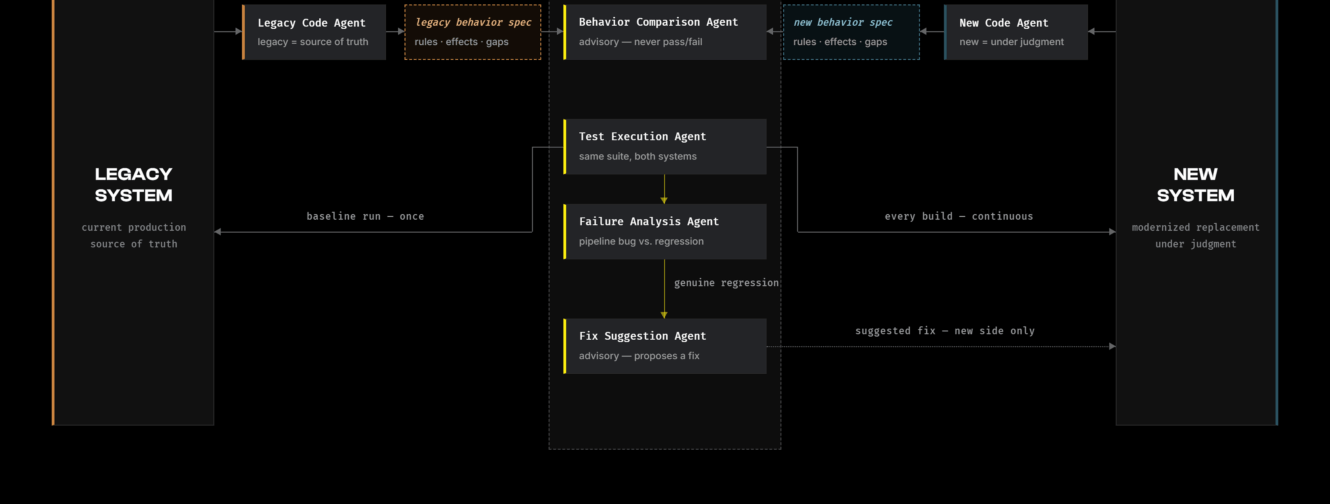
    An executable baseline of legacy behavior, captured before the rebuild begins

  • List icon

    A numbered register of what’s still unknown, each rated by impact

    From the estimate that follows:

  • List icon

    Effort in hours, ranged, with a planning point, never a single number

  • List icon

    Every option costed in full, not as a percentage of a baseline

  • List icon

    A discovery-first roadmap, no plan that opens with construction

  • List icon

    A stable team with the capacity arithmetic shown, not asserted

  • List icon

    Both a plan that fits your deadline and the plan we would recommend

  • List icon

    Gates with pass criteria fixed in advance, so acceptance is never a debate

Modernizing the past. 
Empowering the future.

Let us help you rebuild what’s holding you back.

Start Your Transformation Now //

What Our Software Archaeology Assessment Covers

Six phases, each answering a question that changes the price — architect-reviewed at every boundary, so no phase moves forward on an unverified number.

modernization-solution

Scope

We verify exactly what you’re asking us to price and against which constraints, before any number gets attached. Every delivery option that could apply is logged with its evidence — an option missed here is an option that never gets costed, so nothing moves forward until the inventory is confirmed against source, not assumption.

Architecture

We check whether your documentation and your code actually agree — building as-is and to-be maps and an interface table, then cataloguing every contradiction between documents, interviews, and source. Where they diverge, the code wins; the gap becomes a tracked finding, not a guess baked into the estimate.

Measurement

We measure how much of your system genuinely has to be rebuilt — module by module, file by file, with generated, vendored, duplicated, and out-of-scope volume identified and excluded by name. Inflated line counts get corrected in both directions: dead code stops being priced as work, and hidden risk stops being invisible to the count.

Requirements

We reverse-engineer the specification your system was never given — every process, state machine, permission, and screen, indexed as numbered, complexity-banded requirements that hours can attach to. Effort gets estimated against what the system actually does, not against a line count that misleads in either direction.

Freezability

For every subsystem, we decide what can be kept and what must be rebuilt, and name the ongoing compatibility cost of each freeze decision. Not every legacy component is a liability, some are a portable core in a platform-specific shell, and rebuilding them anyway is an unnecessary cost you don’t need to pay.

Stack

We judge every target technology against the same requirements — suitable, awkward, or fails, no favorites — and hand over a distilled manifest your estimate is built from. The decision is documented against evidence, not against which stack our team prefers to build in.

Our Software Archaeology Techniques

Square icon

Modernization is our core specialization

We aren’t a full-stack agency. We’ve built our team, processes, and tech strategy specifically to tackle legacy issues and help mid-market players scale and innovate.

Square icon

Integration vs. Disruption

We integrate with your workflows, minimizing interference with your developers. While utilizing your Git, CI/CD, and tools, we operate independently, letting your team focus on their work.

Square icon

We classify code file by file, never project by project

A UI project is routinely majority non-interface code. We classify every file and count touch points in ambiguous ones, turning a 100%-rewrite assumption into 63% portable or cheaply decoupled work.

Square icon

We open native and legacy components layer by layer

A platform-locked component is often a portable core in a platform-specific shell. On one 9,892-line component, only ~1,640 lines were OS-tied — porting avoided ~33,700 lines of unneeded work.

Square icon

We reverse-engineer the specification the system never had

Effort should come from what a system does, not lines of code that mislead both ways. On one system, this recovered 438 numbered requirements and flagged 88 as safety-relevant.

Square icon

Respect for Existing Architecture and Leadership

We treat your system efficiently: evolve the functioning parts and replace only the ones that require change.

Our Software Archaeology Approach

Structured Framework

Every engagement runs on the same documented, eleven-stage lifecycle — presale triage, five assessment stages, five execution stages — versioned and improved after every project. Results are repeatable across the team, not dependent on which architect is free.

Deep Archaeology

When a wrong number would be commercially expensive, assessment deepens into a dedicated six-phase pipeline: scope, architecture, measurement, requirements, freezability, stack. Each phase produces evidence the next one builds on, not an assumption it inherits.

Architect Review at Every Phase

Square

A senior architect reviews and signs off at every phase boundary — no phase proceeds on the previous phase’s unreviewed output. At each checkpoint, the architect:

Square

Validates every measurement against its cited evidence

Square

Decides what a contradiction between docs, interviews, and code actually means

Square

Judges which reading of an ambiguous scope is the real one

Square

Flags what’s safe to assume and what has to be escalated to you

Full Traceability

The chain runs evidence → requirement → complexity band → hours → proposal figure, walkable both ways. A challenged line item gets a file and a line back from us, never a defense of methodology or a shrug.

Arrange a call now

Book an expert consultation to uncover gaps in your system. Let us modernize your business to its maximum potential.

Connect with Experts //

Industries

Healthcare
AEC and GIS
Sport
Banking & Financing
Charity and Non-profits
Cybersecurity
Speech Recognition

Software features we build and modernize:

  • Telemedicine and Remote Communication
  • Electronic Medical Documentation
  • Physical and Mental Health Monitoring
  • Child Development Tracking
  • Fall Detection and Movement Tracking
  • Hearing Assessment and Audio Testing
  • Relaxation and Emotional Support
  • Al-Powered Infection Diagnostics
Read more //

Software features we build and modernize:

  • Interactive Object Mapping
  • GNSS Equipment Integration
  • Utility and Infrastructure Mapping
  • Geospatial Data Management
  • Metadata and Interment Record Management
  • Advanced Project Management
  • Visual Analysis and Defect Detection
  • Social Monitoring and Service Mapping
  • Web and Mobile Access to Geospatial Data
  • Data Security and Access Control
Read more //

Software features we build and modernize:

  • AI-Based Motion Tracking
  • Ball and Equipment Tracking
  • Multi-Angle Camera Coordination
  • Performance Analytics and Heatmaps
  • Training Insights and Feedback
  • Integration with Wearables and External Devices
Read more //

Software features we build and modernize:

  • API Management & API Gateway
  • Microservices and Digital Transformation
  • Cloud Platform Integration
  • Security and Regulatory Compliance
  • Advanced Banking Domain Services
  • Analytics and Monitoring
  • Open Banking Solutions
  • Omnichannel Support
Read more //

Software features we build and modernize:

  • Project Discovery & Search
  • Donation Management
  • Organization & Project Profiles
  • Transparency, Reporting & Impact Metrics
  • Service Finder
  • Volunteer & Community Engagement
  • Grant & Funding Opportunities (For Non-governmental organisations)
  • Partner & Corporate Programs
  • Mobile Accessibility
  • Data Insights & Policy Recommendations
Read more //

Software features we build and modernize:

  • Security Operations Center (SOC) as a Service
  • Incident Response & Recovery
  • Cybersecurity Audits
  • Compliance & Certification Support
  • Security Trainings
  • Vulnerability Scanning & Penetration Testing
  • Endpoint, Network, and Cloud Security
  • Offensive AI Technology
Read more //

Software features we build and modernize:

  • Real-Time Voice-Tracking Engine
  • Adaptive Script Following
  • Offline Speech Recognition
  • Multilingual Voice Processing
  • Noise-Tolerant Recognition
Read more //

Corsac’s Experts

List icon

Professional Tech Stagnation Breakers Fighting Tech Stagnation

We focus on modernization for companies unable to grow due to aging systems

List icon

Evolving Existing Architecture and Leadership

We replace only what must be changed, protecting your investment and CTO’s credibility.

List icon

Compliance From Commit to Production

HIPAA, HL7/FHIR, SOC2, GDPR, ISO compliance is integrated into every stage.

List icon

Integration over Disruption

Integrating into your Git, CI/CD, and workflow tools, we make modernization visible, testable, and traceable

List icon

Getting Rid of “Dark Tech Debt”

We uncover hidden costs, feature delays, and security gaps and offer ways of their removal

List icon

Modernization that Fuels Leadership

By providing CEOs stakeholder-ready roadmaps and progress metrics, we enable well-grounded transformation

Most Outsourcing Vendors

List icon

Focus on Delivery vs. Your Business Goals

They fulfill your task without seeking to address the issue at the root

List icon

Lack Domain Expertise

Dispersing the focus, they fail to meet specific Healthcare G and other industry requirements

List icon

Apply a Standardized Modernization Approach

Generalized practices, regardless of the product, team, or business specifics

List icon

Disregard Your Existing Opportunities

Initiate full rewrites instead of using the working parts and considering business context

List icon

Lack integration with your team

Insufficient collaboration leads to poor handover, with documentation debt and weak enablement.

List icon

Code-First Mindset

Development happens in isolation, prioritizing code delivery over actual business value.

Start today!

We’d love to hear from you. Share your vision, and let’s explore how we can make it real together.

    By signing this form you agree to our Privacy Policy

    Our team will

    • 1 Process your request within 1-2 business days.
    • 2 Get back to you with an offer based on your project's scope and requirements.
    • 3 Set a call to discuss your future project in details and finalize the offer.
    • 4 Sign a contract with you to start working on your project.

    Corsac Technologies Corporation

    +1 416 505 4524 Toronto, Canada info@corsactech.com

    Frequently Asked Questions

    It’s the discipline of establishing what a legacy system actually is — its true size, its undocumented behavior, its real requirements — in measured, file-level evidence before a modernization estimate is built. Guesswork gets replaced with a specification.

    A standard audit samples and reports impressions. Software archaeology measures: classifying every file, reverse-engineering a full requirement index, and grading every finding by how it’s known — measured, statically derived, or client-stated. Every number walks back to a file and a line.

    In our experience, client-stated line counts differ from the true in-scope size by a factor of three to ten — usually in both directions at once: dead and vendored code inflates the total while hidden structural risk stays invisible to any count.

    A documented framework sets the shape; the six-phase archaeology pipeline adds depth when the stakes require it. Assessment work that would typically take one to two weeks is compressed into a fraction of that, with an architect still reviewing every phase before it moves forward.

    The reliable approach splits the work in two: AI agents do the exhaustive, uniform research — classifying files, recovering enumerations, cross-referencing sources — at a speed no manual review reaches. Every finding then goes to a human architect, who validates it before it is priced.