
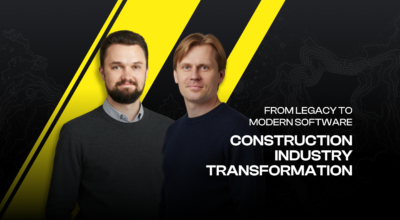
Construction Industry Transformation: From Legacy to Modern Software
Duration: 56m
Watch recording //Software Modernization Company
Your core system still runs the business, but releases take longer each quarter, and only a few engineers know how it works. We modernize systems like this in phases and keep the parts that still work.
We measure the code before we estimate anything. The first step is a Quick System Review that ranks the critical risks in 3–5 days. Our engineers work inside your Git and CI/CD, and your team keeps shipping releases.
SINCE 2007
modernizing legacy
systems for 100+ clients
30%
average maintenance savings on support-focused projects
IN-HOUSE
AI framework for legacy code analysis
HIPAA
SOC 2
and GDPR requirements we design and test against
NDA
signed on request before we open the code

Support and bug fixes for the old system take a bigger share of the IT budget each year while new features wait.
Every release depends on the one or two engineers who can still safely change the core of the system.
Records don’t match across your systems: every integration needs a workaround, and month-end reports take days.
Your runtime or database is out of vendor support, and security audits keep flagging its known vulnerabilities.
Sprints go to retesting after releases break features nobody touched, and the roadmap slips another quarter.
3–5 DAYS

QUICK SYSTEM REVIEW · 3–5 DAYS
Legacy modernization quotes go wrong when someone prices the system they can see. Our modernization review package is where our consulting starts: an assessment of the code and its risks before anyone discusses the budget.
Our engineers review your architecture and code and rank the critical risks that can slow or stop delivery.
A structured report with ranked critical risks and recommended next steps.
Teams that need an independent check of the system before planning a roadmap or a budget.
An in-depth audit of architecture and code that also produces system documentation. If you go ahead with modernization, the audit fee counts toward the project budget.
A report with a modernization roadmap and a substantiated scope estimate for the next phase.
Teams that have decided to modernize and need a plan they can defend to the board.
Real results from real projects: Corsac is among the modernization application companies that implement not just updates of legacy designs but scalable, reinvented systems built for future challenges.

Documented vs. measured size
4,000,000 → 409,833 linesTaken off the documented figure
3.6M lines
Purchase price
15% lowerFindings disputed by the seller
0
Antibiotic Susceptibility Test Time
72h → 3–5hAI Bacterial Classification Accuracy
95%Let us help you rebuild what’s holding you back.
If you’re not sure which service your system needs first, our engineers will recommend one after the Quick System Review.

Unlike a full-stack agency, we built our team and processes around the legacy systems that mid-market companies still run their business on.
In our audits, the documented size of a legacy system has differed from its real in-scope size by 3–10x. We measure the repository before we quote, and every estimate traces back to the code.
If a vendor upgrade or work on a few modules solves the problem, the Quick System Review says so, even if our part of the project gets smaller.
Our delivery team starts from the findings and roadmap of our own audit, with no handoff between an outside consultant and a new vendor.
Sometimes releases are slow because of the process around the code. On one GIS platform, a single backlog and per-ticket releases through CI/CD cut hotfix release time by 70%.
The handover package includes architecture notes, interface descriptions, and test cases, and your team runs the system without depending on us.
You can move an application to the cloud with minimal code changes within weeks. Migrating off an end-of-life stack or restructuring the architecture takes 6 months or more.
Strategy
When It Fits
Complexity
Time to Value
Assess
Audit code, architecture and tech debt independently before any changes are made
When It Fits
Leaders who need a clear roadmap and budget before committing to modernization
Complexity
Low
Time to Value
Days to weeks
Rehost
Move existing apps to AWS, Azure or Google Cloud with minimal code changes
When It Fits
Companies paying for aging on‑prem servers or end‑of‑life hosting
Complexity
Low
Time to Value
Weeks
Replatform
Make targeted changes so the app runs on managed cloud services (databases, containers, CI/CD)
When It Fits
Teams that want better stability, lower ops overhead and cost optimization (autoscaling, pay‑for‑use) without a redesign
Complexity
Low to Medium
Time to Value
1–3 months
Refactor
Clean up and restructure code without changing what the product does
When It Fits
Stable products where code quality, complexity or tech debt slows delivery, makes changes risky, or blocks testing, onboarding and further improvements
Complexity
Medium
Time to Value
Gradual, first results in weeks
Re-architect
Restructure the system (modular, API‑first, cloud‑native) while the technology may stay the same
When It Fits
Products that hit limits in scalability, performance, reliability, security, maintainability or integration, or that need faster, safer and more independent deployments
Complexity
High
Time to Value
6+ months
Migrate & Rebuild
Move step by step from an end‑of‑life stack (VB6, Delphi, Oracle Forms, AngularJS, .NET Framework) to a modern one
When It Fits
An end‑of‑life or unsupported stack that blocks new features, hiring, security, compliance or integrations
Complexity
High
Time to Value
6–18 months
Modernize Data
Move legacy databases and scattered data sources into a unified, cloud‑ready data layer
When It Fits
Reporting is slow, data lives in silos, or analytics and AI can’t use it
Complexity
Medium to High
Time to Value
3–9 months
Retire & Replace
Swap non‑core modules for proven off‑the‑shelf tools and integrate them with your core product
When It Fits
Features that don’t differentiate you and cost more to maintain than to replace
Complexity
Variable
Time to Value
1–6 months, depending on integration effort
Time to Value shows typical ranges. We confirm the timeline for your system, based on its size, code condition and integrations, in a free Quick Review that takes 3–5 days.
Missed it live? Watch the recording
Get a practical framework for reviewing AI-generated code, closing the context gaps that cause technical debt, and turning fast prototypes into reliable, scalable production systems.
The video link lands in your inbox immediately.
Legacy products usually age at several layers at once: a Web Forms front end, an Access database, servers patched by hand. For each layer, you’ll see the legacy technologies we take over and the supported stack we move them to.
Legacy
Modern Stack
Application Environments
Legacy
Modern Stack
Languages & Frameworks
Legacy
Modern Stack
Data Sources
Legacy
Modern Stack
Platforms & Infrastructure
Legacy
Modern Stack
GIS
Legacy
Modern Stack
If your stack isn’t listed, we assess it during the Quick Review.

We check each new component against the old system’s behavior on real data before users switch to it.
We replace only the parts that must change and keep the rest of your past investment in production.
HIPAA, SOC 2, and GDPR requirements shape our architecture decisions and test plans.
We work as a separate track in your repository and pipeline, and each change stays testable and traceable.
We find the hidden costs behind delayed features and security gaps and remove them in order of business impact.
CEOs receive roadmaps and progress metrics they can take to the board and investors.
Your in-house team knows the old system, a vendor knows current stacks, and each has to learn the other half.
Both options often lean toward a full rewrite because finding which parts still work takes more effort.
Requirements such as HIPAA are often checked near the end, when changes cost the most.
In-house work waits behind urgent fixes, and a vendor pulls the same senior developers into supervising it.
Quotes based on documentation count dead and generated code as work, then change once the real system turns up.
Leadership gets sprint reports and has no numbers to take to the board.
Manual analysis of a large legacy codebase can take weeks, and the dependencies analysts miss turn into budget overruns later. We built our AI modernization framework in-house to shorten that analysis, and our engineers use it from the first stage of a project.

The framework is built on a Retrieval-Augmented Generation (RAG) architecture with a coordinated group of AI agents, and it turns legacy source code into a searchable dataset.
Semantic indexing and Abstract Syntax Tree (AST) analysis map the dependencies and architectural bottlenecks in the code. Specialized agents sort the files by origin and generate tests from the current system’s behavior.
An architect signs off on the analysis before each phase begins.
Faster system understanding. Dependency maps and complexity scores for each module replace weeks of reading code by hand.
Fewer regressions. Tests generated from the current behavior catch broken functions before they reach production.
A timeline you can track. The roadmap splits the work into phases, each with a measurable milestone.
Rollback at every step. If a new service fails after the switch, we move users back to the old one and fix the problem before the next attempt.
Less dependence on legacy specialists. Documentation and tests let new engineers work on code that only a few people understood before.
Browse recordings from past sessions on modernization, AI, and product strategy.
Watch in full or skip to the parts that matter to you.
Duration: 56m
Watch recording //
Duration: 32 m
Watch recording //
Duration: 42 m
Watch recording //AI tools need clean data, stable integrations, and business rules someone can explain. Legacy systems often hide all three, and an AI pilot built on top of such a system can stall before it reaches production.
In legacy systems, critical rules often sit inside monolithic code and undocumented database layers. We extract them into separate, documented modules, and AI-driven decisions then follow the same rules your operations do.
We replace brittle point-to-point connections with versioned APIs and event-driven integration, because AI results depend on the data other systems send to the model. Each API version defines the data format the model receives.
During each phase, the old and new components work side by side, and any step can be rolled back. Your team can start an AI pilot on a modernized module while the rest of the system keeps serving users.
In regulated industries, someone has to explain why the system made a decision. We design the modernized system so your team can trace each AI output back to its data and rules and keep that trail current as the rules change.
AI agents classify every file as hand-written, generated, vendored, or duplicated, and an architect reviews the dependency map and the list of unknowns before planning starts.
Result: a dependency map, the true in-scope size, and a ranked risk list.
We group components by business domain and decide which of them to rewrite, refactor, or wrap. New services then take over the old system’s functions one domain at a time.
Result: a phased roadmap and an estimate you can check.
We turn what each component does today into golden-master tests and run them against the old system first.
New code has to pass the same tests before it replaces the old code.
Result: documented components with behavioral-parity tests.
Each step has monitoring and a rollback path. At handover, your engineers get the documentation and our support until they run the system on their own.
Result: a running system your engineers own.
Igor or Andrew can talk it through with you on a call and suggest where to start.

CEO, Legacy Modernization Strategist
Turns legacy system risk into business decisions: budget, timing, vendor lock-in, handover, and M&A readiness. 30+ modernization projects led in regulated industries.

CTO, Legacy Systems Architect
18+ years in legacy modernization. Explains what happens under the hood of an aging system: hardcodes, bus factor, digital facades, and how to fix the core itself.
Book a 30-minute call with Igor or Andrew at a time that suits you.
Within one business day, we'll reach out to schedule a call.
If you asked for an NDA, we'll sign it before the call.
On the call, Igor or Andrew will go through your system, goals, and constraints with you.
Together, we'll agree on the next step: a quick technical review, a full audit, or a scoped proposal.
There is no fixed price: we quote each project after we measure the system. Legacy systems differ in size, stack, integrations, and documentation, and a quote based on documents alone can miss the real scope by a factor of three to ten. On one client system, documentation listed 4,000,000 lines, while the true rebuild scope was 409,833. If you continue from the Quick System Review to a Full Technical Audit and then to modernization, the audit fee counts toward the project budget.
You don’t have to, and we choose the approach only after the assessment shows what the code contains. Depending on your risk tolerance and product maturity, we rewrite the whole codebase, rewrite selected modules, or wrap stable legacy parts behind adapters and replace them later. New components replace the old ones gradually, and the parts that still work stay in place.
Sometimes it is, and the Quick System Review will recommend it when the platform still has vendor support and the code is in workable shape. An upgrade moves your current architecture to a newer version of the same platform, together with its coupling and undocumented logic. If the review shows that the architecture is what slows you down, we propose a phased migration and name the modules that can stay.
We plan each phase so your users keep working. Old and new components run in parallel, and we switch users to each new part only after it passes the parity tests, with a rollback path at each step. If a short cutover window is unavoidable, for example during a database switch, we agree on it with you in advance and schedule it outside peak hours.
Your developers stay on the live product while our engineers run modernization as a separate track inside your Git, CI/CD, and task tracker. Throughout the project we document the architecture and train your team, and at handover your engineers own and maintain the new code.
Undocumented systems are a common starting point for us. We reconstruct the system’s behavior from the source code with dependency maps, module-by-module measurement, and a specification reverse-engineered from the code. Anything we cannot confirm goes into a list of documented unknowns, and the estimate accounts for each of them.
We use an AI modernization framework that we built in-house. It maps dependencies across your code, which shortens the analysis stage, and turns the legacy system’s behavior into tests. An architect reviews its output at the end of each phase and makes the architectural decisions. If you need an NDA, we sign it before we get access to your code.
We migrate systems built on COBOL, Delphi, Visual Basic 6, Oracle Forms, FoxPro, ColdFusion, RPG on IBM i (AS/400), Perl, MS Access, DB2, .NET Framework, and AngularJS. Typical targets are current .NET, Java with Spring Boot, TypeScript, Kotlin, and Python, running on Azure or AWS.
It depends on the strategy: a cloud move with minimal code changes takes weeks, and migrating off an end-of-life stack or restructuring the architecture takes six months or more. We give you the timeline for your system with the phased roadmap from the Full Technical Audit. A Quick System Review takes 3–5 days after we get access, and the Full Technical Audit takes 2–3 weeks.
Any system ages, and our goal is a codebase that a new team can pick up without months of onboarding. We leave documentation, tests, and a working release process behind, and agree on estimation and backlog practices with your team. In our experience, even a well-maintained system needs a planned modernization investment every 8–12 years, and we help you see that cycle coming.